


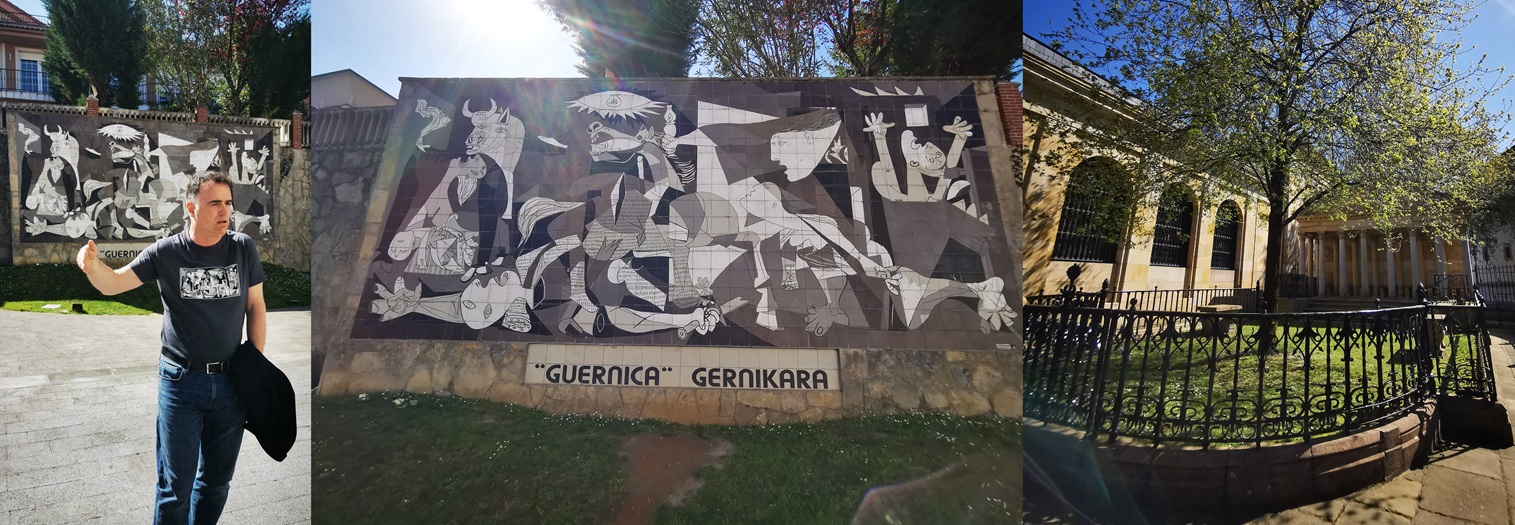
My interest in Pablo Picasso’s Guernica and its relationship with various Basque painters and sculptors stems, naturally, from my passion for the arts. But it also responds to a deeper motivation: to understand how this historical and cultural episode has shaped the artistic memory of the Basque Country.
As a host to international travelers who come to this land with a genuine cultural curiosity, I consider it essential to explore not only Picasso’s work, but also the dialogue his painting generated among Basque artists of different generations.
With this purpose in mind, I have studied and selected those Basque artists whose careers present one of these three connections with Guernica:
- artists who created their own interpretations of the bombing of Guernica-Lumo inspired by Picasso’s work;
- artists in whose work a direct influence of the Málaga-born painter can be perceived;
- or artists who maintained a personal or intellectual relationship with Picasso and his artistic circle.
In the first part of this study, I addressed Picasso’s relationship with three Basque painters: Francisco Iturrino, Gustavo de Maeztu, and Jesús Olasagasti. The three maintained close ties with the artist from Málaga during the first decades of the 20th century, roughly between 1901 and July 1936, on the eve of the outbreak of the Spanish Civil War.
This second part is set precisely in the dramatic historical context that began with the coup d’état of July 17th and 18th, 1936, against the Second Spanish Republic. The narrative takes us to 1937, the year of the 1937 International Exposition in Paris, where Guernica was presented to the world for the first time.
In the third part of this series, we will examine the first artistic interpretations of Guernica created in the Basque Country itself between 1938 and 1939. Subsequent chapters will explore:
- the influence of Guernica on the avant-garde of Basque painters and sculptors between 1940 and 1975;
- the works created after the death of Francisco Franco and the beginning of Spanish democracy until the end of the 20th century;
- and finally, the contemporary reinterpretations that the 21st century has contributed to the Basque art scene.
With this framework established, we can delve into the historical context that preceded the creation of one of the most influential works of 20th-century art.
Brief historical context of the Basque Country in 1936 and 1937
In February 1936, the left-wing political coalition known as the Popular Front won the Spanish general elections. In the Basque Country, the Basque Nationalist Party supported the Republican forces with the aim of advancing the approval of a Statute of Autonomy.
A few months later, on July 17th and 18th, 1936, a faction of the Spanish army—among whose leaders was Francisco Franco—revolted against the Republican government, thus beginning the Spanish Civil War.
Of the three Basque provinces, only Álava largely aligned itself with the rebels. A military offensive was launched from Pamplona to secure control of the border with France by capturing Irún. Although this objective was eventually achieved, the initial campaign failed in its attempt to consolidate control over San Sebastian.
In September 1936, the President of the Republic, Manuel Azaña, entrusted Francisco Largo Caballero with forming a government. As the rebel troops advanced towards Madrid, the Republican government moved its headquarters to Valencia. That same autumn, the founder of the Spanish Falange, José Antonio Primo de Rivera, was executed in the Alicante prison.
The first president of the Basque Government
In Madrid, the new Statute of Autonomy was approved by the Spanish Parliament on October 1st, 1936. And in the Basque Country, a few days later, the nationalist leader José Antonio Aguirre took office as the first president of the Basque Government in the Gernika Assembly House, under the historic Gernika Tree.
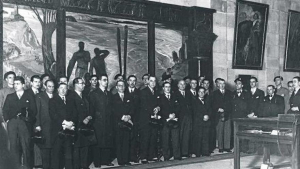
Inauguration of the first Basque Government in 1936 at the Guernica Assembly House. Photo by Deia.
This place holds profound symbolic significance in Basque political and social tradition. Since the Middle Ages, the lords of Biscay swore there to uphold the laws of the territory, known as fueros. From the Old Charter of 1452, the General Assemblies were to be held literally “under the tree.”
The symbolic significance of the Gernika oak was further solidified in the 19th century thanks to the famous anthem Gernikako Arbola, composed in 1851 by José María Iparraguirre, whose verses urge: “Eman ta zabal zazu munduan frutua” (spread its fruit throughout the world).
With this historical and symbolic backdrop, Iparraguirre pronounced the oath that inaugurated the first Basque government in contemporary history. Understanding this context is essential to understanding why the destruction of Gernika in 1937 had such a profound emotional impact on Basque society.
To raze Biscay in order to take Bilbao
By the end of 1936, much of the Basque provinces—especially large areas of Álava and Gipuzkoa—were under the control of the rebel forces. Only the province of Biscay remained largely in Republican hands. The Basque Government maintained its allegiance to the Republic and organized the defense and administration of the territory.
For several months, the front remained relatively stable, until April 1937, when a new military offensive began in the north. The strategic objective was clear: to conquer Bilbao and control its powerful steel industry.
On March 31st, 1937, the Italian air force bombed the towns of Durango and Elorrio. This marked the beginning of the offensive on Biscay. A few weeks later, on April 26th, 1937, the city of Gernika-Lumo was destroyed by a devastating aerial bombardment.
British journalist George Steer described the tragedy in the pages of The Times and The New York Times, noting that the city—a symbolic center of Basque tradition—had been razed for more than three hours by German planes:
Guernica, the oldest Basque city and the center of its cultural tradition, was completely destroyed yesterday afternoon by insurgent bombers. … Guernica was not a military target; the objective of the bombing was apparently the demoralization of the civilian population and the destruction of the cradle of the Basque race. [1].
These accounts had an immediate international impact. For the first time, the world saw images in newspapers of a European city destroyed from the air. In the Parisian edition of Thursday, April 29th, 1937, the newspaper Le Petit Journal reported for the second consecutive day on the bombing and strafing of Guernica as part of the campaign to capture Bilbao. Further down, it announced the imminent opening of the Paris Exposition:
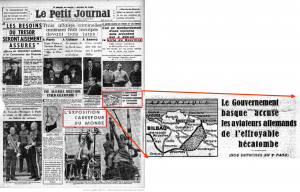
Le Petit Journal. April 29, 1937. National Library of France
The emotional and political impact was enormous. Among those who received that news in Paris was Pablo Picasso. On May 1st, 1937, after participating in a popular demonstration in the French capital, the painter began the first sketches of the work that would transform that episode into one of the universal symbols against war.
Spanish art shortly before the 1937 Paris International Exposition
The cultural life of Republican Spain did not stop while, in parallel, the political, military and social events of 1936 and 1937 were developing. Quite the contrary: the intense cultural atmosphere experienced by many Spanish cities also became an increasingly influential element in the political, social and symbolic spheres of the time.
Some notes on the Spanish and Basque cultural atmosphere in 1936
In early 1936, the cities of Barcelona, Bilbao, and Madrid organized the first solo exhibition in Spain dedicated to Pablo Picasso, promoted by the cultural organization ADLAN (Amics de l’Art Nou).
In Bilbao, between February 19th and 25th, 1936, the newly opened Casa Arte gallery, located on the Gran Vía, exhibited 24 works by the Málaga-born painter, created between 1908 and 1935. Picasso was already an internationally recognized and admired artist, and the most culturally vibrant Spanish cities aspired to match that recognition.
On December 22nd, 1934, Spain had received an invitation to participate in the Exposition Internationale des Arts et des Techniques dans la Vie Moderne, to be held in Paris between May 25th and November 25th, 1937. However, the preparations for Spain’s participation faced several difficulties. Some regions—such as the Balearic Islands, Catalonia, Castile, and the Basque Country—requested their own pavilions, which initially dampened interest in a unified representation.
Finally, on April 28th, 1936—almost exactly one year before the bombing of Guernica—the Ministry of Industry and Commerce officially approved Spanish participation. With the outbreak of the Civil War a few months later, the project lost momentum again, as the country’s resources had to be concentrated on the war effort.
Interestingly, just a few weeks before the start of the war, between May 22nd and June 10th, 1936, the Exposition de Peinture Basque (Basque Painting Exhibition) was held in Paris. Some of the most prominent Basque painters of the first third of the 20th century participated: Bienabe Artía, Juan de Aranoa, Aurelio Arteta, the Arrúe brothers, Benito Barrueta, Antonio de Guezala, Isidoro Guinea, Víctor Landeta, Julián de Tellaeche, José María de Ucelay, and Ignacio Zuloaga. Some of them would later see Guernica and Picasso at the 1937 Paris exhibition, either as visitors or as participants in the show itself.
Meanwhile, the painter Manuel Losada, director of the Bilbao Fine Arts Museum and the Museum of Modern Art, kept both museums open until the city suffered its first bombing raid on September 25th and 26th, 1936. British journalist George L. Steer recounted these events in several international newspapers:
“Fulfilling their threat, yesterday the rebels sent their mercenary air force over Bilbao… Bilbao is not a besieged city. The battlefront is many kilometers from our city. The bombing was not aimed at the surrender of a besieged city, but at sowing terror and spilling the blood of people who had not taken part in the fighting.”[2]
The first Basque Government: promoter and protector of heritage
In parallel with these events, the Spanish government appointed Pablo Picasso director of the Prado Museum on September 19th, 1936, a position the artist never formally assumed.
Shortly afterward, in October 1936, the Provisional Government of the Basque Country was established in Bilbao. Thanks to the Statute of Autonomy, this new institution had direct jurisdiction over Basque cultural heritage, leading to the creation of the Department of Justice and Culture.
Its head, Jesús María de Leizaola, appointed the Basque painter José María Ucelay as Director General of Fine Arts, Archives, and Libraries at the end of October. Several Basque artists collaborated with him, including Julián de Tellaeche, Antonio de Guezala, John Zabalo, and Mauricio Flores Kaperotxipi.
One of the department’s first initiatives—along with educational policies—was to inventory and safeguard as many works of historical and cultural heritage as possible from the three Basque provinces.
The works that could not be moved were protected in situ, while many others were stored in the Free Warehouse at the Uribitarte Wharf in Bilbao. Several residences in the Las Arenas neighborhood (Getxo) were also temporarily used as emergency storage facilities, and museum protection measures against bombing were reinforced.
In December 1936, the Basque Government headquarters, located in the Hotel Carlton, was decorated with 38 paintings from various museums and public collections. Among them were:
- The Wedding of Aránzazu (copy), by the Álava painter Francisco de Mendieta, from the Archaeological Museum
- Kissing of the Hands of the Oath of the Fueros in 1474 by King Ferdinand the Catholic (1609), also by Mendieta, from the Bilbao Fine Arts Museum
- Various works from the Bilbao Museum of Modern Art, with pieces by José Arrúe, Ricardo Arrúe, Juan de Echevarría, Darío de Regoyos, Julián de Tellaeche or Valentín de Zubiaurre.
A well-known photograph from February 1937 shows Lehendakari José Antonio Aguirre in his office at the Hotel Carlton with the painting Women of the Coast (c.1922) by Julián de Tellaeche in the background [3].
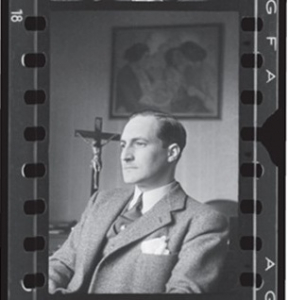
Negative of Aguirre in his office at the Carlton Hotel with Women from the Coast, by Tellaeche (c.1922)
Art and culture as a weapon of republican propaganda
In late 1936, the writer and Spanish ambassador to Paris, Luis Araquistáin, wrote to his minister advocating for Spanish participation in the exposition:
“It seems advisable to participate in the exposition and to immediately take the necessary steps to do so, thus giving the impression of security and that the Government continues to work on matters of this kind. In the worst-case scenario, and if it proves difficult to secure the participation of private exhibitors, it would always be possible to construct an inexpensive but dignified pavilion and display works of art, propaganda, etc.”[4].
The idea was to create a Spanish Pavilion that would project an image of institutional normalcy, serve as a platform for anti-war propaganda, and showcase Spain’s cultural richness to the world. The Republic needed support, as Europe was turning its back on it. Interestingly, Araquistáin is a Basque surname, as his father was from Elgóibar (Gipuzkoa).
The initiative led to several changes in the project’s organization. Among the selected intellectuals were José Gaos as general commissioner, José Bergamín as deputy commissioner, Josep Renau as director general of Fine Arts, Max Aub as cultural attaché, and the Bilbao-born writer Juan Larrea as head of the news agency.
They were joined by some of the most prominent figures of the Spanish artistic avant-garde associated with the Republican cause: the filmmaker Luis Buñuel, the sculptors Alberto Sánchez and Julio González, the painter Joan Miró, and, shortly afterward, Pablo Picasso.
Araquistáin himself laid the foundation stone of the Spanish Pavilion in Paris on February 27th, 1937. During the ceremony, he delivered a speech that perfectly reflects the spirit of the project:
“For Republican Spain, war is merely an accident, an imposed and temporary evil that does not prevent it from continuing to create spiritual and material works. It is precisely for this reason that it fights: to be free in intellectual creation, in social justice, and in material prosperity.”
Basque art prepares for the Paris Universal Exposition
While the foundation stone of the Spanish pavilion was being laid, Basque councilor Jesús María de Leizaola appointed José María Ucelay as commissioner of the Basque Commission in February 1937. This commission was created to organize the Basque Section within the Spanish pavilion.
The commission was divided into several areas: Culture and Fine Arts, the Association of Basque Artists, and Industry, Social Activity, and Agriculture.
Its members included artists such as Julián de Tellaeche, Antonio de Guezala, Jesús Uruñuela, the illustrator John Zabalo, the sculptors Higinio de Basterra and Vicente Larrea, the architect Tomás Bilbao, and the archivist Juan Irigoyen.
At the same time, in March 1937, Leizaola commissioned the choreographer Segundo Olaeta to have his children’s dance group, Elai Alai, from Gernika, perform in the Republican pavilion of the exhibition. Following the bombing of the city, the group embarked on a tour of several European countries, where they were enthusiastically received by figures such as Cardinal Verdier.
Three days before the bombing of Guernica, on April 23rd, 1937, José María Ucelay departed for Paris. On May 19th, he was officially presented as commissioner of the Basque Section of the Spanish Pavilion.
Faced with the possibility of Bilbao’s fall, the Basque Government decided to send numerous works of art under its custody to the French port of La Rochelle, along with bank funds and various cultural archives. Only the collection of Old Master paintings and sculptures remained under the care of Manuel Losada at the Uribitarte storage facility.
The flames of Guernica illuminate the Spanish conflict to the world
On April 27th, 1937, the day after the bombing of Guernica, Lehendakari Aguirre declared on Radio Bilbao:
“German airmen in the service of the Spanish rebels have bombed Guernica, burning the historic city held in such veneration by all Basques…a sanctuary that records the centuries of our freedom and our democracy.”
The news spread rapidly throughout Europe. That same day, during a human rights demonstration in Paris, many citizens learned for the first time of the tragedy that had occurred in the Basque town.
According to a well-known—though disputed—anecdote recounted by Ucelay, upon exiting the metro on the Champs-Élysées, he happened to run into Juan Larrea, to whom he related the events. Larrea then went to inform Picasso and encouraged him to use the tragedy as the subject for the mural the artist was preparing for the Spanish Pavilion.
Beyond the accuracy of this story, the international impact of the bombing was immediate. Picasso, deeply affected by the news coming from Spain, found in that event the creative catalyst for one of the most influential works of 20th-century art: Guernica.
In May 1937, the artist himself would declare:
“The Spanish Civil War is the battle waged by reaction against the people, against freedom… In the mural I am working on, which I will title Guernica, I clearly express my hatred for the military caste that has shipwrecked Spain in an ocean of pain and death”.
Basque art and Picasso’s Guernica travel to the Paris exhibition
The Basque painter Julián de Tellaeche, deputy commissioner of the Basque commission, was in charge of selecting the works that would represent Basque art in the exhibition. He chose artists from the late 19th century to those active at the time, many of them members of the Association of Basque Artists. Among the movements represented were Impressionism, Fauvism, Costumbrismo (regionalist painting), and Social Realism. The final list included 48 painters and 8 sculptors.
With the help of the painter Kaperotxipi, Tellaeche packed and prepared the works for transport to Paris. From the beginning of May 1937—precisely when Picasso was beginning to paint Guernica—until mid-June, numerous pieces departed for different French ports.
Along with them traveled other works destined for safekeeping, some by Francisco de Goya, as well as documentary materials, damascening from Éibar, and various institutional archives.
On June 12th, 1937, Basque art officially entered the Spanish Pavilion at the Paris Exposition, accompanied by Julián de Tellaeche. A few days later, Picasso would follow with Guernica.
As art critic John Berger would write decades later:
“What he painted were his own sufferings as he received the news from his country every day”.
Basque art and culture at the 1937 Paris Universal Exposition
The International Exhibition of Arts and Techniques of Modern Life, held in Paris in 1937, was much more than a grand showcase of progress. During the six months it was open, visitors could clearly perceive the tension gripping the world.
In its pavilions, emerging totalitarian powers and threatened democracies coexisted—in an almost unsettling proximity: Nazi Germany, Fascist Italy, the Soviet Union, the Spanish Republic… The ideological conflict that would soon erupt into the Second World War was visible in every exhibition space.
The Spanish Civil War, which had begun just a year earlier, became one of the most striking symbols of that turbulent time. And no work managed to express that tragedy with such intensity as Pablo Picasso’s Guernica.
Spanish fine arts in the Republic pavilion
On July 12th, 1937, nineteen days after the opening of the Universal Exposition, the Spanish Republic’s pavilion finally opened its doors.
The effort involved in its construction had been extraordinary, considering the logistical and economic difficulties of a country in the midst of war. Despite its architectural simplicity, the Spanish pavilion became one of the most visited and memorable of the entire exposition.
Undoubtedly, the presence of Guernica contributed decisively to its renown. But the pavilion’s success was also due to an exceptional group of artists and cultural offerings. According to the Spanish Ministry of Culture, the pavilion stood out:
“…for the splendid work of architects Luis Lacasa and José Luis Sert; for the participation of some of the most important artists of the time, Picasso, Miró, Julio González, Calder, Alberto Sánchez, etc.; for its original and modern use of a medium that was just beginning, photomontage; for its propaganda potential; for the perfect fusion, in short, of such a diverse array of exhibits, ranging from the visual arts to publications, including the display of mercury, folk art, socio-economic and military information, theater, film, song, dance, poetry, etc.”[5]
The exhibition brought together a wide range of cultural expressions: visual arts, publications, theater, film, music, dance, literature, folk arts and even social, economic and war information about Republican Spain.
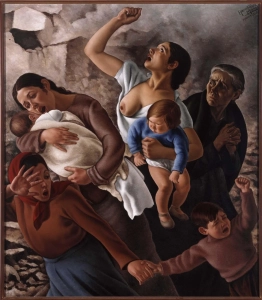
“Madrid 1937 (Black Planes)”. Horacio Ferrer.
Among the most outstanding Spanish works were:
- Guernica, by Pablo Picasso;
- the mural The Reaper, also known as The Catalan Peasant in Rebellion, by Joan Miró;
- Madrid 1937 (Black Planes), by Horacio Ferrer;
- and the monumental sculpture The Spanish People Have a Path That Leads to a Star, by Alberto Sánchez, located at the entrance to the pavilion.
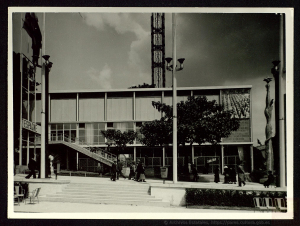
Interestingly, according to contemporary accounts, Alberto Sánchez’s sculpture made an immediate impression on the public. The pavilion’s commissioner, José Gaos, noted in a letter that the work had been “the pavilion’s greatest success“.
General view of the Spanish Pavilion at the Paris International Exposition. On the right, the sculpture The Spanish People Have a Path That Leads to a Star, by Alberto Sánchez. Photo: Documentary Center of Historical Memory.
Guernica, although striking from the outset, had not yet achieved the universal symbolic dimension it would acquire over the decades.
The Basque section of the Spanish pavilion
Within the Republican pavilion, the Basque Country had a specific presence that reflected both its cultural identity and the political drama the territory was experiencing at that time.
The Euskadi section consisted of two large photomontages designed by José Renau.
The first depicted an armed gudari (warrior or soldier) next to a map of the Basque Country, accompanied by a poem by Paul Éluard entitled “The Victory of Guernica“. The message evoked the resilience of an ancient people in the face of adversity.
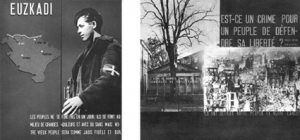
Photomontages by José Renau in the Euzkadi (Basque Country) section of the Spanish Pavilion at the 1937 Paris Expo (Photos from the Reina Sofía Museum).
The second panel established a powerful visual contrast. One of its images features the Tree of Gernika, a historical symbol of Basque liberties and the place where the kings of Castile swore to respect the fueros (charters of rights and privileges). The caption describes it as a “symbol of the democracy of the Basque people”. The opposite image showed the ruins of the city after the bombing.
The contrast between the two scenes expressed a powerful idea: the destruction of Guernica as an attack not only on a city, but on the political and ancestral identity of a people.
The Basque Artists Section at the Paris exhibition
The Basque Country-related visual arts section, located in another part of the pavilion, brought together a remarkable representation of artists from the Basque Country. The works came primarily from two institutions:
- the Bilbao Museum of Contemporary Art and
- the Carlton Hotel in Bilbao, which served as the headquarters of the Basque Government during the war.
According to documentation from the Center for Historical Memory, the selection included works by 48 Basque painters and 8 Basque sculptors. Among the most prominent artists were:
- Aurelio Arteta
- Darío de Regoyos
- Ramón de Zubiaurre
- José Arrúe
- Bernardino Bienabe Artía
- Julián de Tellaeche
- Francisco Iturrino
- Jesús Olasagasti
In the first part of this study, we discussed Iturrino and Olasagati‘s work and their relationship with Picasso.
In total, around 17 of their works were ultimately exhibited at the 1937 Universal Exposition. These paintings depicted scenes deeply connected to the Basque imagination: coastal landscapes, agricultural work, folk traditions, maritime scenes, and festive celebrations.
Among them were works such as:
- Basque Fishermen and Pilgrims or Rustic Idyll, by Aurelio Arteta
- Basque Pilgrimage, by José Arrúe
- Bridge of Ondárroa, by José Benito Bikandi
- The White Cabin Boy and Sailboats, by Julián de Tellaeche
- For the Victims of the Sea, by Valentín de Zubiaurre
- and Saint Lucy, Durango, by Darío de Regoyos.
Today we know that eleven of these works are part of the collection of the Bilbao Fine Arts Museum. Nine of them are listed by this museum as having been exhibited at the 1937 Paris Exposition:
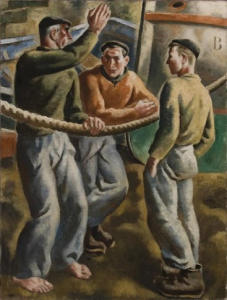
Basque fishermen by Aurelio Arteta, c. 1930-1935.
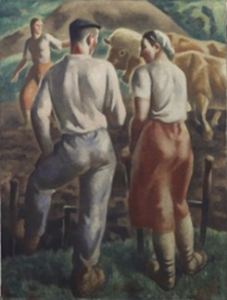
Layadores or Rustic Idyll by Aurelio Arteta. c. 1930-35
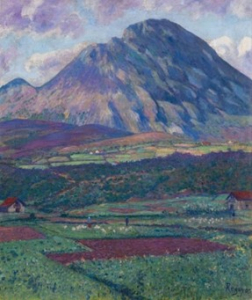
Santa Lucía, Durango by Darío de Regoyos, 1907.
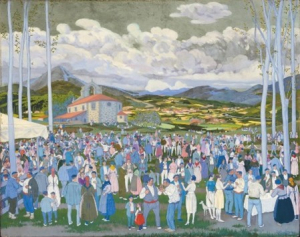
Basque pilgrimage by José Arrúe. 1921
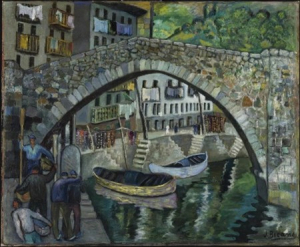
Ondárroa Bridge by José Benito Bikandi, c 1925
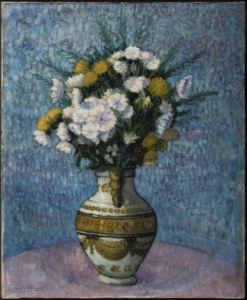
Vase by Juan de Echevarría, c1912
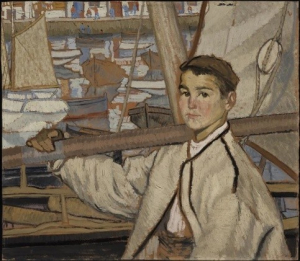
The White Cabin Boy by Julián de Tellaeche. c. 1922-1924
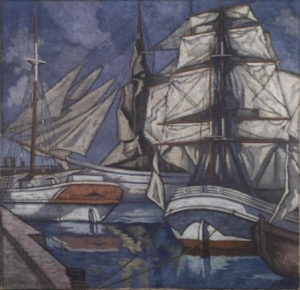
Sailing ships by Julián de Tellaeche. First half of the 20th century.
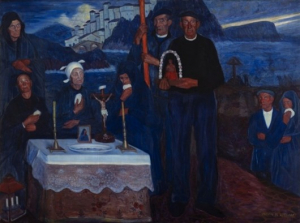
Sailing ships by Julián de Tellaeche. First half of the 20th century, 1914.
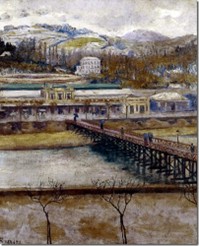
The Urumea by Darío de Regoyos, 1904
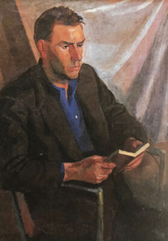
Portrait of a man reading by Bernardino Bienabe Artía, 1934
Remember that the last two paintings shown are not listed as being on display in the exhibition, out of the 11 works that are in the Fine Arts Museum of Bilbao.
Darío de Regoyos and Bernardino Bienabe: details of their work and participation
Among all the artists represented, Darío de Regoyos occupied a unique position. He was the only painter who was able to show three works in the exhibition: El Urumea, Monte La Rhune, and Santa Lucía.
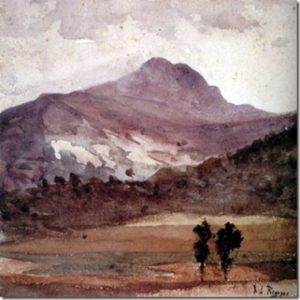
Monte La Rhune by Darío de Regoyos, 1886
This fact is particularly striking considering the limited space in the Basque section and the large number of works available. In those years, Regoyos was considered one of the most renowned painters on the Spanish scene, even more so than such well-known figures as the Basque painter Ignacio Zuloaga or the Valencian Joaquín Sorolla. The absence of Zuloaga or Gustavo de Maeztu, both friends of Picasso at one point, from the selection has been interpreted by several historians as a consequence of their political sympathies with the Nationalist side.
Regoyos was an established artist and essential to young artists like Picasso in the late 19th and early 20th centuries. Picasso’s melancholic and somber Blue Period might remind us of the Black Spain movement of which Regoyos was a part. Regoyos is a particular kind of Impressionist who focused heavily on light and landscapes, while Picasso, on the other hand, was more versatile in his themes and a creator of new ways of seeing and painting.
Bienabe, for his part, also associated with Picasso in Paris and experienced the technical freedoms of the French avant-garde. Picasso explored Spanish identity extensively, while Bienabe focused on that of his native Basque Country (Euzkadi). Both did so through depictions of popular figures and human types.
With Regoyos, the painter Bienabe shared several similar themes: the use of the Basque landscape and other places by their wanderlust, an interest in light, and Impressionism. Regoyos leaned more towards modern Impressionism and Symbolist Expressionism, while Bienabe was more Post-Impressionist and Fauvist.
Sculpture, crafts and other Basque cultural expressions on display
The existing documentation does not allow us to confirm with certainty whether any Basque sculptures were ultimately exhibited within the pavilion. The surviving images primarily show sculptural works by Picasso, Alberto Sánchez, Julio González, and Alexander Calder.
However, the Basque Country was indeed represented in other cultural spheres. Curator José Gaos mentions the presence of artisans from Éibar in the section dedicated to crafts and performing arts in the central courtyard. There was also a small café there, run by the Basque Antonio Rementeria, located just a few meters from Guernica.
The Basque cultural representation also included:
- works from the Éibar School of Arms
- exhibitions on agriculture and fishing
- demonstrations of traditional games such as Basque pelota
- and various artistic expressions.
These included theatrical performances, the opera Amaya, folklore shows, and performances by sword dancers and children’s choirs. Even Basque cinema was present with productions such as The Oldest Village in Europe. The Youngest State in Europe.
A dramatic historical context
While the exhibition remained open in Paris, events unfolded rapidly in Spain.
In June 1937, just days after Picasso finished Guernica, General Emilio Mola, one of the main ideologues of the military uprising, died in a plane crash.
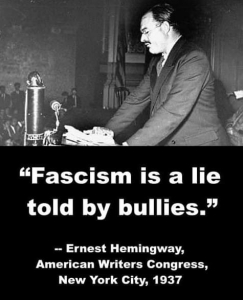
In the Basque Country, the battles were approaching Bilbao. Between June 16th and 19th, decisive fighting took place in the mountains of Monte Artxanda, on the outskirts of the city. Finally, Bilbao fell to Franco’s army on June 19th, 1937.
The Lehendakari (President of the Basque Government) José Antonio Aguirre went into exile shortly afterward.
Meanwhile, internationally, intellectuals and artists followed the Spanish Civil War closely. The writer Ernest Hemingway, recently returned from the front, denounced the bombings of cities like Madrid, Bilbao, and Guernica in New York.
The Spanish conflict had already become the prelude to a much larger war.
First impact of Picasso’s Guernica on the Government and on Basque painters and sculptors
The town of Gernika, and especially its tree, have represented the freedoms and democratic identity of the Basque people for centuries. However, although Picasso titled his great mural against the barbarity of war Guernica, the Basque Government—and in particular its president, José Antonio Aguirre—did not initially embrace it as a work representative of the Basque soul.
I will share some information and reflections on the initial impact of this painting denouncing the fascist bombing of civilians. I will focus especially on the reactions of the provisional Basque Government, several Basque artists associated with the 1937 Paris International Exposition, and some prominent figures in Basque society at the time.
I do not intend to be exhaustive. I simply want to share a few insights that help to better understand the complex relationship between Guernica, Basque cultural sensibility, and the political and artistic context of that historical moment.
The Basque Government poses in front of Picasso’s Guernica at the Spanish pavilion
The photograph reproduced below is probably one of the best pieces of evidence of the institutional acceptance —at least political and propagandistic— that Guernica received from the Basque Government in the summer of 1937.
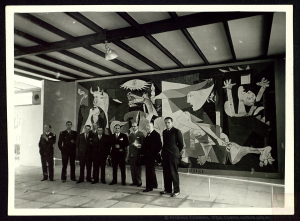
Members of the Basque Government and the Republic in front of Picasso’s Guernica, Paris exhibition 1937
In front of Picasso’s mural stood representatives of the Basque Government alongside officials from the Spanish Republican pavilion in Paris. Beyond their differing ideological and aesthetic sensibilities, they all understood that the work was becoming a powerful international denunciation of the barbarity of war.
President Aguirre’s first thoughts on Picasso’s Guernica
Much has been written—and exaggerated—about the supposed negative reaction of Lehendakari José Antonio Aguirre upon seeing Guernica for the first time. However, the reality seems far more nuanced.
Guernica was, above all, a mural denouncing the war, exactly what the Republic had requested of Picasso. It was another matter entirely whether many of those who saw it in 1937 fully understood its artistic language or felt a connection to it from a Basque cultural sensibility still closely tied to local customs and figurative realism.
And this didn’t only apply to conservative or nationalist politicians. Some Basque artists associated with the pavilion, such as José María Ucelay, also expressed reservations about Cubism and the European avant-garde.
It’s worth remembering something essential: when a person sees a work titled Guernica for the first time, they instinctively look for what they recognize as their own. They look for the tree, the town, the faces that represent identity, the familiar symbols. They look for their emotional memory.
And yet, Picasso didn’t paint the Basque town of Gernika literally.
Neither you nor I actually see the town on the canvas. What we see is something else: the universal pain caused by war.
That was possibly Aguirre‘s initial great bewilderment, and that of so many others.
What was Basque about that painting? Very little, on the surface. There were no Basque soldiers, no farmhouses, no Gernika Tree. Picasso spoke another language. A symbolic, poignant, universal language.
The break between Basque tradition and European avant-garde
Looking back at the works of the Basque painters in the Basque section of the Paris pavilion, the contrast is striking.
It’s difficult to find aesthetic connections between those paintings and Guernica. Realism, genre scenes, seascapes, rural landscapes, and figurative compositions predominated. There was academicism, social awareness, and Basque cultural identity, but very little formal rupture comparable to Picasso’s.
Perhaps Bernardino Bienabe Artía, with his Portrait of a Man Reading, was one of the Basque artists closest to a modern sensibility within that selection.
The distance between the visual universe of Arteta, Ucelay, or Tellaeche and the expressionist cubism of Guernica actually reflected a much deeper tension: that between Basque cultural tradition and the new European avant-gardes of the 20th century.
Aguirre facing Guernica
Imagining José Antonio Aguirre standing before Guernica helps us understand many things.
A young, deeply Basque nationalist, Catholic, and aesthetically conservative Lehendakari (President of the Basque Government), contemplating an immense Cubist mural bearing the name of the most sacred symbol of Basque liberties… but where he doesn’t visually recognize his own people.
The shock must have been immense.
However, even though he didn’t feel an aesthetic connection to the work, Aguirre did understand something fundamental: the extraordinary propagandistic and symbolic power of the painting.
Naming it Guernica transformed the suffering of the Basque people into an international cry.
The world was beginning to look toward the Basque Country.
Leizaola, the Minister of Culture, also speaks out
Among Basque leaders, Jesús María de Leizaola was probably the one who best understood the historical and cultural significance of Guernica.
The Minister of Justice and Culture understood that Picasso had achieved something that went beyond the literal representation of the bombing: he had transformed Basque suffering into a universal symbol against violence and fascism.
Leizaola also admired the modern value of Cubist language as an art form capable of transcending the mere photographic depiction of events.
Guernica and the Basque artists
José María Ucelay was probably the Basque artist most critical of Guernica during those early years.
He rejected Cubism, distrusted the avant-garde, and believed that a work about Gernika should have been created using visual codes closer to Basque tradition. For him, Aurelio Arteta would have been the ideal painter to represent that collective tragedy.
However, Julián de Tellaeche presented a much more complex and interesting position.
Although he also didn’t fully embrace the Cubist language, he understood that Picasso had achieved exactly what the Republic sought: to create an image impossible to ignore.
Guernica inevitably overshadowed much of the Basque art exhibition. But it also led thousands of international visitors to discover the art and cultural life of the Basque Country for the first time.
Juan Larrea and the intellectual birth of Guernica
If there is a Basque intellectual inseparable from the history of Guernica, it is Juan Larrea.
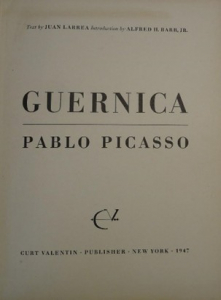
Cover of the essay: Guernica – Pablo Picasso, 1947, by Juan Larrea.
A surrealist poet, personal friend of Picasso, and profound connoisseur of the Parisian avant-garde, Larrea understood the symbolic potential of the work before almost anyone else.
He actively participated in the painter’s creative circle during the mural’s development and subsequently dedicated a significant part of his life to interpreting, defending, and promoting it internationally.
His essay, Guernica: Pablo Picasso (1947), was one of the first attempts to decipher the painting’s complex symbolic universe.
Larrea saw in Guernica much more than a political denunciation: he saw a new, modern mythology of human suffering.
Explanatory notes and references
Those wishing to better understand the relationship between Picasso and several important Basque artists of the early 20th century can also read the first part of this article, previously published on this same blog by Aitor Delgado Tours. In it, I analyze the Malaga-born painter’s connections with figures such as Jesús Olasagasti, Gustavo de Maeztu, and Francisco Iturrino, essential figures in Basque painting of the time.
Following these connections, I attempted to locate documentary evidence regarding the opinions that Olasagasti and Maeztu may have held about Picasso’s Guernica. However, I have not yet found sufficiently conclusive evidence. In Iturrino‘s case, the artist had died before the creation of the famous mural presented at the 1937 International Exposition in Paris.
In the third part of this article, I will continue exploring the relationship between Picasso, Guernica, and several of the leading Basque painters and sculptors during the final years of the Spanish Civil War, coinciding with the work’s first major international tour.
A journey that would definitively transform Guernica into one of the most powerful artistic, political, and emotional symbols of the 20th century.
Art is a lie that makes us see the truth. Pablo Picasso
References
[1] STEER, George, “The Tragedy of Guernica. Town Destroyed in Air Attack”, The Times, April 28, 1937. STEER, George, “Historic Basque Town Wiped Out”, The New York Times, April 28, 1937. Note: translation by the author.
[2] Sources: SSGCS, AGALBI, El Liberal, El Noticiero Bilbaíno, Euzkadi, La Gaceta del Norte, George L. Steer
[3] © Estate of Chim (David Seymur)/ Magnum Photos/ Courtesy ICP/ www.davidseymur.com
[4] Guernica – Picasso Legacy. Ministry of Culture. Directorate General of Fine Arts, Archives and Libraries
[5] Alix, J.: Spanish Pavilion: International Exposition of Paris, 1937. Ministry of Culture. Madrid. 1987. p.7



 US Phone #: +1 (917) 267 7569

Leave A Comment